
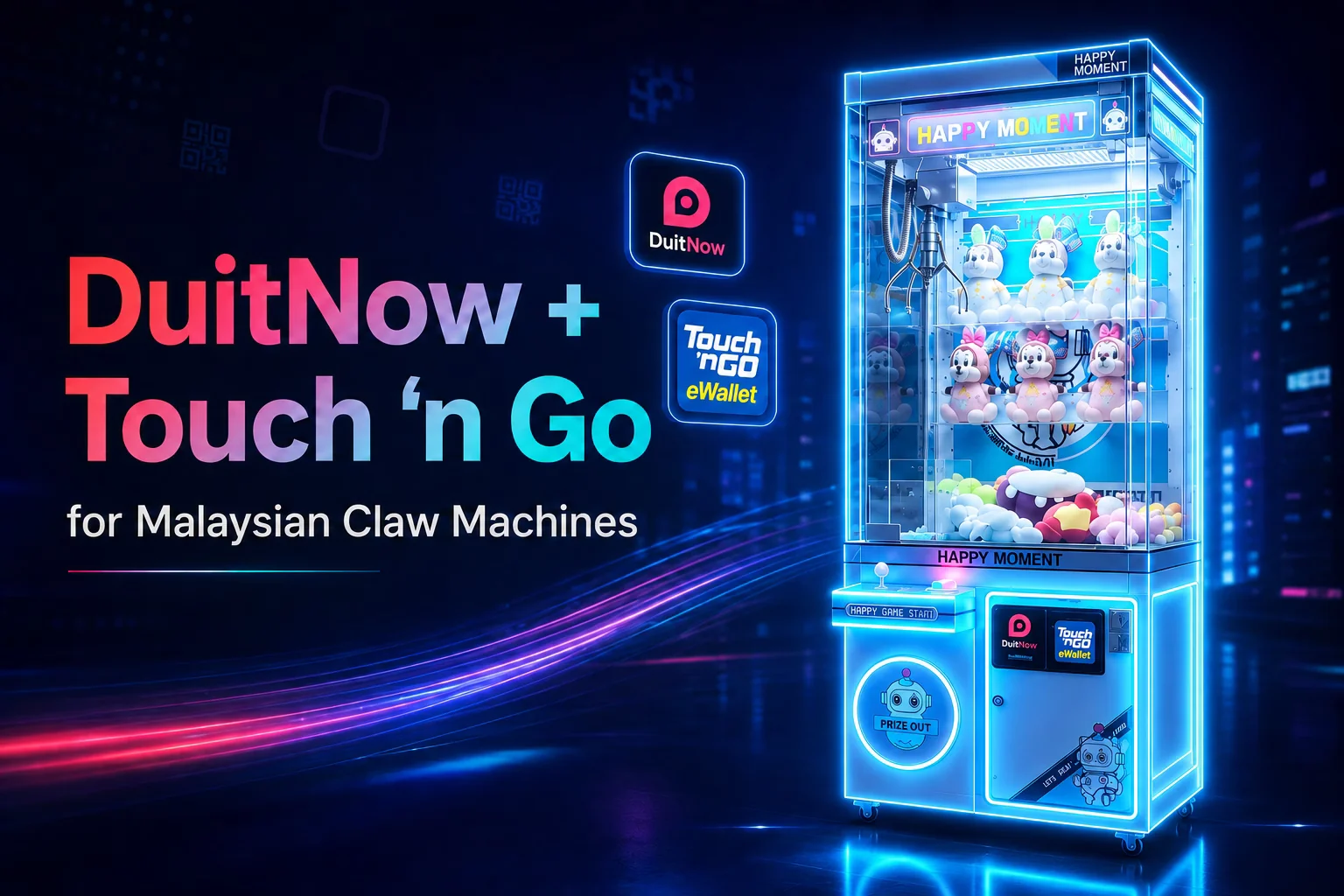
Cashless payment on a claw machine is not simply a QR sticker beside a coin slot. A reliable installation has to connect a confirmed Malaysian payment to exactly one machine credit, reject incomplete or duplicated transactions, survive daily public use, and leave the operator with records that reconcile against settlement. That is the engineering problem behind a dependable DuitNow claw machine in Malaysia.
At our Panyu manufacturing base, we build the machine side of that system. We prepare the cabinet, power branch, communication or pulse interface, wiring harness, payment-terminal mount, mainboard settings, and final acceptance test. The Malaysian operator or payment provider supplies the approved merchant account, settlement relationship, SIM or network plan, and supported terminal. This division of responsibility matters. It separates a factory-integrated machine from a reseller promising a vague “Touch 'n Go reader” without defining how payment confirmation reaches the game board.
Why Cashless Access Matters in Malaysia
Malaysian customers increasingly arrive at malls, family entertainment centers, laundromats, restaurants, and convenience sites ready to pay by phone. A coin-only machine creates friction when a player has no ringgit coins, cannot find a change counter, or does not want to buy a venue-specific token. Cashless access removes that interruption at the exact moment the illuminated cabinet and prize have created intent.
Cashless performance varies by venue, customer mix, play price, and operating hours. A Kuala Lumpur mall, a Johor Bahru supermarket, and an unattended dobi cannot be evaluated with one fixed growth percentage. We engineer the installation so an operator can measure results by machine ID, location, play price, payment method, day, and time. This turns cashless conversion into a location-specific operating metric for pricing and expansion decisions.
The operational value extends beyond convenience. Digital records reduce coin counting, expose differences between mainboard play counts and payment reports, and support faster route decisions. Coins or tokens may still remain useful as a fallback, especially where mobile coverage is inconsistent. The strongest configuration is often hybrid rather than cashless-only.
Coins, Tokens, DuitNow QR and eWallet Options
“Touch 'n Go payment” can describe different products, so the interface must be named precisely. Touch 'n Go eWallet can scan a merchant's interoperable DuitNow QR. That phone-based flow is different from accepting a physical Touch 'n Go card, an RFID product used for transport or tolling, or a bank-card contactless transaction. Each route can involve different hardware, commercial agreements, and settlement rules.
| Payment method | Machine-side requirement | Operating strengths | Important limitation |
|---|---|---|---|
| Coins | Coin acceptor, secure cash box, calibrated pulse output | Works offline and is familiar | Collection labor, change friction, and cash exposure |
| Venue tokens | Token acceptor plus token sales or exchange point | Closed-loop control and prepaid play | Extra inventory and customer exchange step |
| Static DuitNow QR | Merchant QR plus a verified controller or separate operator confirmation process | Low visual footprint and broad app compatibility | A sticker alone cannot automatically credit the machine; customer-entered amounts complicate unattended control |
| Dynamic DuitNow QR | Connected screen or terminal, payment confirmation, and machine-credit interface | Exact price and transaction reference can be created for each play | Depends on network, provider support, and correct failure handling |
| Card or NFC terminal | Certified terminal with a supported vending or pulse interface | Fast tap flow and possible multi-payment support | Hardware, fees, onboarding, and protocols vary by provider |
Under PayNet's merchant-presented specification, a static DuitNow QR can omit the amount and let the customer enter it, while a dynamic QR can carry the transaction amount and a point-of-initiation method for a reusable or one-time flow. The specification also supports merchant and terminal references useful for unattended locations. Touch 'n Go Digital's own support guidance confirms that its eWallet can pay at a merchant by scanning DuitNow QR. Together, those facts explain why a separate “TNG RFID reader” is not the default requirement for Touch 'n Go eWallet acceptance.
How a Digital Payment Becomes One Machine Credit
Most conventional claw-machine mainboards already understand an input from a coin acceptor. Each valid coin produces an electrical pulse, and the programmed price setting converts one or more pulses into a play. A compatible cashless controller can use that same logic, but it cannot safely “trick” the board before payment is confirmed. The correct sequence is controlled and auditable.
- Price requestThe terminal loads a fixed play price or creates a dynamic QR for that machine and session.
- Customer authorizationThe customer scans with Touch 'n Go eWallet or another DuitNow-compatible app and approves the payment.
- Provider confirmationThe acquirer or terminal validates the transaction. A screen animation without server or terminal confirmation is not sufficient.
- Credit commandThe controller closes an isolated relay or sends the defined pulse pattern to the coin or credit input.
- Mainboard acceptanceThe game board adds one paid credit, enables play, and increments its internal count.
- ReconciliationThe payment record, terminal ID, machine ID, amount, and play count remain available for exception review.
Electrical details vary by machine and terminal. A cabinet may expose a dry-contact input, a low-voltage pulse input, a serial connection, or a vending protocol. The payment device may require 12 VDC, 24 VDC, or its own regulated supply. We verify voltage, ground reference, pulse polarity, pulse width, debounce behavior, connector pinout, and the board's credit ratio before building the harness. Opto-isolation or a relay prevents a payment peripheral from injecting noise or damaging the game controller.
Software behavior matters as much as wiring. Duplicate callbacks require idempotent handling so one transaction cannot create two credits. Timeouts need a visible state. A payment confirmed after the QR session expires needs a defined reconciliation path. Network loss must not produce a free credit, and a terminal reboot must preserve enough transaction state for investigation. For a route with mixed models, each terminal and cabinet receives a durable machine identifier rather than a handwritten location nickname.
GrabPay, Boost, banking apps, and Touch 'n Go eWallet may all reach the same merchant-presented DuitNow QR when the acquiring setup supports interoperable payments. That reduces the need to mount a separate branded reader for every wallet. A provider's supported apps, merchant discount rate, settlement timing, refunds, connectivity, and dashboard functions remain commercial questions for that provider.
Factory Integration and Quality Control
Our advantage as a direct source factory is control over the cabinet before shipment. A general payment reseller can supply a terminal, but it may not control the steel panel, access door, internal power layout, mainboard parameter table, or packing method. We coordinate those parts during production for Claw Machines intended for Malaysia.
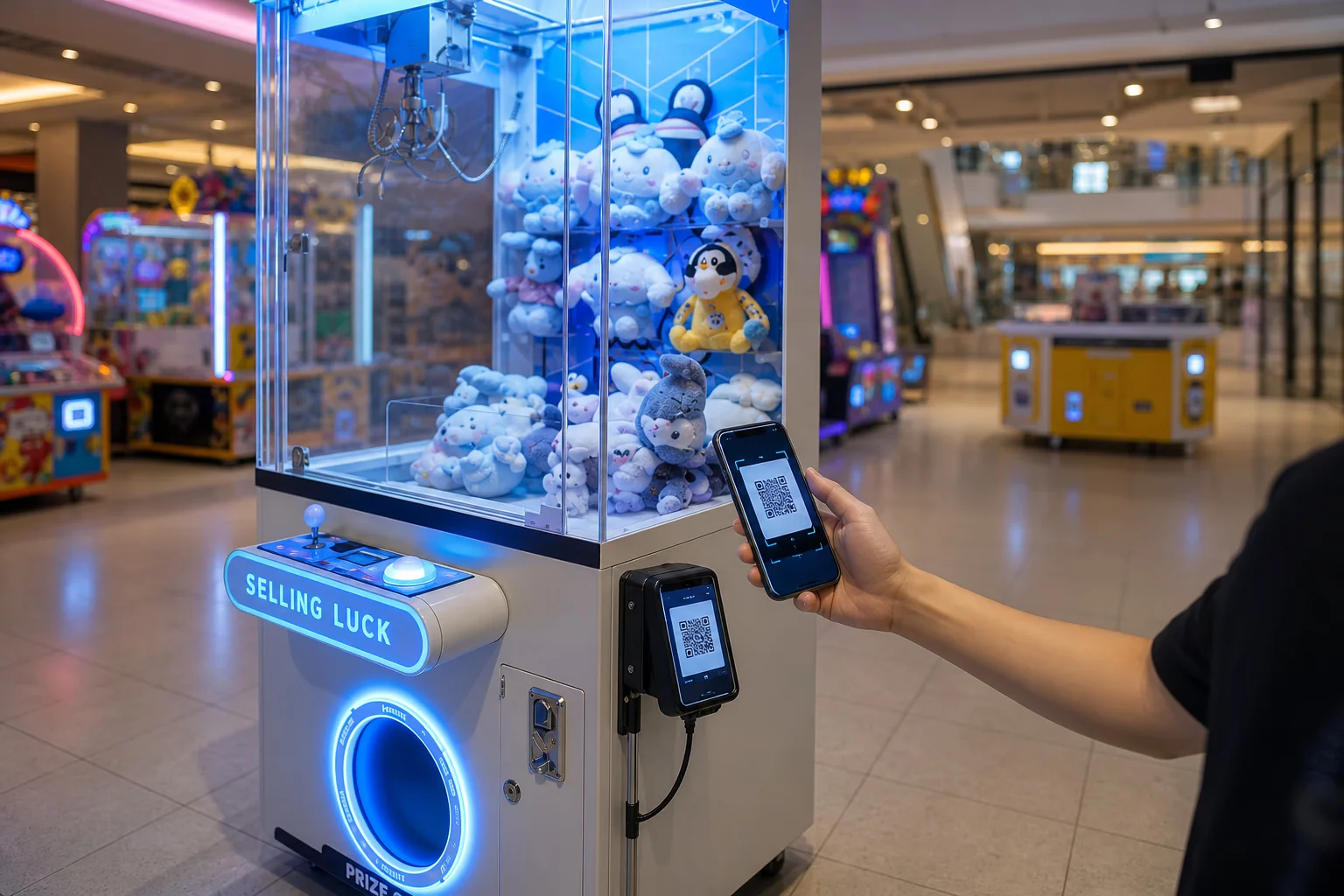
The integration begins with the terminal's mechanical drawing and interface document. We reserve a sightline that is easy to scan without blocking the joystick, prize window, service door, or coin path. The bracket receives appropriate fasteners and cable strain relief. Wiring runs inside the locked cabinet where possible, with labeled connectors and separation from moving gantry parts, high-current lighting, and mains voltage. English or Malay operating labels can be applied around the payment point, and the original coin acceptor can remain active for a hybrid configuration.
During assembly, our technicians record the mainboard credit setting and match it to the agreed price logic. We test repeated successful payments, insufficient or canceled payments, rapid consecutive transactions, power cycling, network recovery, and manual coin fallback. The normal machine test still covers gantry travel, claw strength, joystick and button response, prize sensor behavior, lighting, locks, cabinet finish, and burn-in. This combined pre-shipment quality control catches interactions a terminal-only bench test cannot reveal.
The shipment package can include a labeled harness, wiring diagram, terminal bracket, spare relay or interface module, connector list, parameter record, and test video. Our packing team secures externally mounted hardware or removes vulnerable components into labeled cartons before LCL or container loading. After arrival, remote video troubleshooting can compare the Malaysian installation against the factory acceptance record instead of starting from an unknown wiring state.
This is how LeYou creates a practical “plug-and-play in Malaysia” result. It means the confirmed terminal and machine interface have already been fitted and tested; it does not mean a machine bypasses local merchant onboarding, local telecommunications, venue approval, or provider activation.
B2B and Wholesale Purchasing Guide
A cashless quotation becomes useful when it defines the whole deployment rather than adding “QR ready” as a line item. For a single pilot, we can match one terminal specification to one mainboard and document the result. For distributors and multi-site operators, the same work becomes a repeatable SKU strategy.
Distributors often benefit from a consolidated cabinet platform with selectable payment kits. A base SKU can retain coin and token acceptance, while a Malaysia cashless kit adds the bracket, regulated power branch, labeled harness, isolated input, and reserved terminal aperture. That approach reduces spare-part variation and lets local partners install an approved provider without cutting finished cabinets in the field. Mixed container orders can combine full-size, mini, and specialty machines while preserving common connectors and service labels.
Chain operators may add custom cabinet colors, Pantone-matched panels, bilingual decals, QR instructions, terminal branding zones, and centralized machine IDs. Our cashless payment customization work coordinates those visual requirements with physical access and electrical serviceability. We do not print a provider's trademark or present a terminal as certified until the operator has supplied approval and production artwork.
Information That Closes the Technical Gap
- Target machine model, quantity, play price, and whether coins or tokens remain active
- Malaysian payment provider, terminal model, merchant onboarding status, and technical contact
- Terminal voltage, peak current, connector, output type, pulse timing, API or webhook behavior, and network method
- Mounting drawing, ventilation requirement, antenna clearance, cable length, and tamper-resistance needs
- Settlement currency, refund process, offline behavior, dashboard exports, and per-machine reporting
- Venue power standard, deployment city, expected route conditions, and spare-parts plan
Our equipment matching process converts that information into an interface decision before production. The result can be a dynamic-QR screen with pulse output, a provider terminal with a dry-contact relay, or a prepared cabinet for local installation. If the payment provider supplies only an API and no machine-side controller, the project also requires an IoT gateway or approved integration partner. That dependency is identified before the order is packed.
A Practical Malaysia Deployment Plan
We normally structure deployment in three stages. The first stage is a provider-approved pilot using the final merchant account, SIM or Wi-Fi arrangement, real play price, and intended venue conditions. The pilot proves payment confirmation, credit delivery, reconciliation, network recovery, and customer instructions.
The second stage standardizes the parts and records. We lock the terminal mount, harness revision, mainboard parameter set, machine ID format, operator label, and spare list. Payment totals are compared with both terminal reports and machine play counters. Any difference is classified as a canceled payment, delayed confirmation, duplicate event, manual coin play, service credit, or hardware fault.
The third stage scales the proven configuration across production. Incoming terminal batches are checked against the approved model, wiring is continuity-tested, and each completed cabinet follows the same acceptance sequence. Operators can then compare cashless share, plays per day, downtime, and collection labor by site. Those local records provide a sounder expansion case than an industry-wide promise of a fixed revenue increase.
Cashless Claw Machine FAQ
Can Touch 'n Go eWallet pay a DuitNow QR on a claw machine?
Yes. Touch 'n Go eWallet supports scanning a merchant's DuitNow QR. Automatic play still depends on a terminal or controller that receives verified confirmation and signals the machine.
Does a static DuitNow QR sticker add credit automatically?
No. The sticker presents payment details but has no electrical path to the mainboard. Automatic credit requires a verified transaction event and a compatible controller, relay, pulse, serial, or vending interface.
Is dynamic QR better for an unattended claw machine?
Dynamic QR is generally easier to control because it can include the exact price and a transaction reference for one session. The provider's actual terminal and API capabilities determine the final flow.
Can cash and cashless payments operate together?
Yes. We can preserve the coin or token acceptor while adding a separately isolated cashless input. Mainboard settings and reconciliation procedures account for both sources.
Can Leyou activate a Malaysian DuitNow merchant account?
No. A Malaysian acquiring bank or payment provider handles merchant approval, settlement, and service terms. We integrate the approved hardware and interface into the machine at the factory.
Build a Malaysia-Ready Configuration
A useful cashless project starts with one machine model, one approved payment terminal, and one clearly documented credit signal. From that baseline, our factory can prepare a repeatable cabinet and harness for a pilot, distributor SKU, or multi-location rollout. Malaysian operators can send the terminal datasheet, target play price, machine quantity, and destination city to discuss a Malaysia cashless configuration. We can return a machine recommendation, interface review, sample or pilot plan, and direct factory quotation without forcing a full-fleet commitment.
Payment behavior referenced in this guide follows PayNet's merchant-presented DuitNow QR specification and Touch 'n Go Digital's DuitNow QR payment guidance. Provider features and commercial terms remain subject to the selected Malaysian acquirer.